

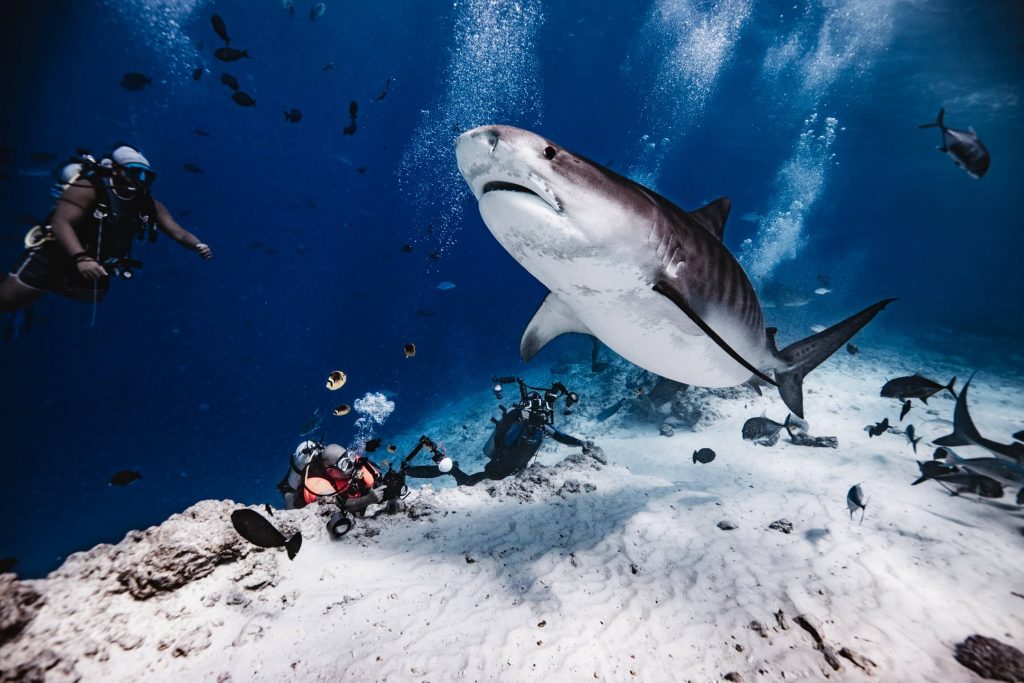
Discover Fuvahmulah’s legendary tiger sharks, explore Tiger Harbour’s shallow dive sites, and uncover groundbreaking research and the mysteries of the deep Equatorial Channel surrounding this extraordinary Maldivian island.
Fuvahmulah, Maldives: Tiger Shark Profile
Estimated Total Population
The broader tiger shark population around Fuvahmulah is estimated to exceed 1,000 individuals. As the Maldives’ only volcanic island, Fuvahmulah rises like a tower underwater mountain directly from the deep Indian Ocean.
Powerful, nutrient-rich equatorial currents sweep past its shores, acting as a natural magnet that attracts an abundance of fish and oceanic pelagic species.
However, current scientific research is predominantly limited to shallow recreational dive depths. The vast, un-surveyed deep-water ecology surrounding the extinct submarine seamount remains largely unexplored.
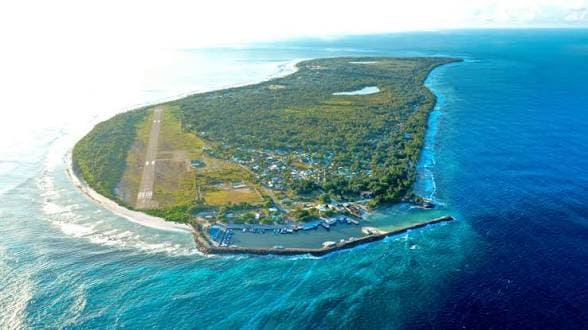
Unlike typical Maldivian islands that form part of multi-island atolls, Fuvahmulah stands as a solitary oceanic island in the middle of the deep Equatorial Channel. This breathtaking aerial shot captures the lush green interior, the domestic airport runway, and the bustling harbor that serves as the gateway to world-class pelagic encounters. The world-famous Tiger Harbour dive site is located just off the harbour entrance at GPS coordinates 0°18’24″S, 73°26’29″E (-0.30658, 73.4414). Photo Courtesy: Fuvahmulah Central Dive
Because transient and resident open-ocean sharks heavily utilize these deeper, pelagic-rich drop-offs rather than just the shallow reefs, the hidden population is believed to be vastly larger than what local cataloging alone reveals.
- Destination: Fuvahmulah, Maldives
- Famous dive sites: Tiger Harbour, Tiger Wall, and Farikede
- Scientific name: Galeocerdo cuvier
- Research depth: Less than 11 metres in recent standardized surveys
- Major research finding: 239 individual tiger sharks identified during a seven-year study
- Total catalog: Local marine biologists and partner dive centers track over 300 individual tiger sharks (including roughly 44 to 37+ males and 250+ to 276+ females depending on the registry snapshot).
- Identification method: Each shark is cataloged using photo and video analysis of its natural side stripes, scars, and dorsal fin shapes/markings.
- Underwater landscape: Shallow reef, steep reef slopes and deep ocean waters
- Research significance: Repeated shark sightings and strong site fidelity among adult females
- Biggest unanswered question: How extensively do tiger sharks use the deeper waters around Fuvahmulah?
- Best known for: Exceptional year-round tiger-shark sightings and year-round shark-diving opportunities
- Estimated Population: The wider population is estimated to exceed 1,000 individuals. As the Maldives’ only volcanic island rising from deep equatorial channels, its nutrient-rich currents attract massive pelagic aggregations in un-surveyed deep waters beyond shallow recreational dive limits.
Fuvahmulah’s Tiger Sharks: A Shallow Window into a Deep Ocean
Fuvahmulah, Maldives, is internationally recognised for its remarkable tiger-shark encounters. Yet one of the most fascinating aspects of this oceanic island is the contrast between the shallow waters where divers observe these powerful predators and the vast Indian Ocean surrounding them.
At Tiger Harbour, Fuvahmulah’s best-known tiger-shark dive site, encounters take place in remarkably shallow water. A landmark scientific study documented the aggregation using underwater observations and photographic identification, revealing 239 individual tiger sharks over seven years. More recent research has also standardized observations at depths below 11 metres.
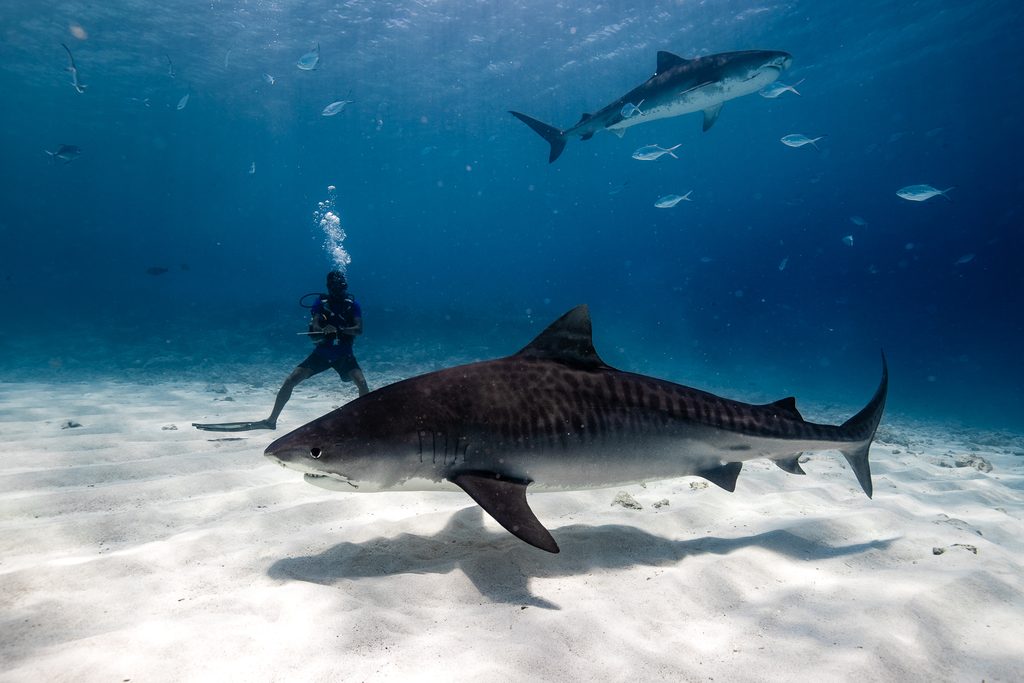
Published in Scientific Reports in 2024, the landmark study documented repeated visits by tiger sharks, particularly adult females, demonstrating that Fuvahmulah is an important site for understanding their behaviour and residency.
But these findings raise another question: how much of Fuvahmulah’s tiger-shark world remains beyond the reach of conventional dive surveys?
“Read the peer-reviewed research in Scientific Reports” (https://www.nature.com/articles/s41598-024-73079-3).
Tiger Harbour: From Traditional Fishing to a Global Shark-Diving Destination
Fuvahmulah’s tiger-shark story is closely connected to the island’s traditional tuna fishery.
Following the construction of the harbour in 2004, discarded fish remains created a predictable feeding opportunity near the harbour entrance. Researchers have documented the association between fish discards and tiger-shark activity in this area.
Today, fish remains are used in managed encounters to support shark tourism and observation. However, the sharks were not introduced to the island by the diving industry. They were already part of the surrounding marine ecosystem.
Tiger Harbour has consequently become more than a celebrated dive site. It is an accessible location where researchers can study individual sharks, document their return visits and investigate how environmental conditions influence their presence.
Tiger Wall: Where the Reef Meets the Deep Indian Ocean
Beyond the shallow harbour environment, Fuvahmulah’s underwater landscape changes dramatically.
The island is a true oceanic island rather than part of a typical Maldivian atoll. Its narrow fringing reef descends towards deep water, creating a striking transition from accessible recreational dive sites to habitats beyond ordinary diving depths.
Tiger Wall provides a compelling perspective on this underwater geography.
A diver might watch a large tiger shark glide past in relatively shallow water while the nearby reef slopes towards the deep blue. The encounter occurs within a small, accessible part of a much larger marine environment.
This is why the geography matters: Tiger Harbour is an observation point, not a complete representation of the ocean habitat available to tiger sharks around Fuvahmulah.
What Lies Beyond 30 Metres?
Recreational diving observations reveal only part of the underwater landscape. The commonly applied recreational-diving depth limit in the Maldives is 30 metres, although applicable rules and operator requirements should always be confirmed.
Below that boundary, the reef and surrounding ocean extend into deeper habitats that conventional recreational surveys cannot comprehensively investigate.
Tiger sharks are highly mobile predators capable of using different marine environments. However, it would be premature to assume that a large, undocumented population necessarily occupies Fuvahmulah’s deeper waters.
The scientifically important point is that the number of sharks documented at Tiger Harbour is not a complete census of every tiger shark using the surrounding ocean.
Deep-water research is needed to establish how individuals use the reef slopes, offshore waters and other habitats around the island.
What Does Science Actually Know About Fuvahmulah’s Tiger Sharks?
The seven-year study identified 239 individual tiger sharks, approximately 84.5% of which were female. Adult females repeatedly returned to the study area, demonstrating strong site fidelity.
A separate peer-reviewed study published in Marine Biology in May 2026 examined environmental influences on tiger-shark presence at Tiger Harbour. Researchers conducted hundreds of surveys and found that environmental conditions, including sea-surface temperature and monsoon patterns, influenced the presence of different groups of sharks.
Together, these findings show that Fuvahmulah’s aggregation is scientifically significant and that shark presence is influenced by more than the availability of food alone.
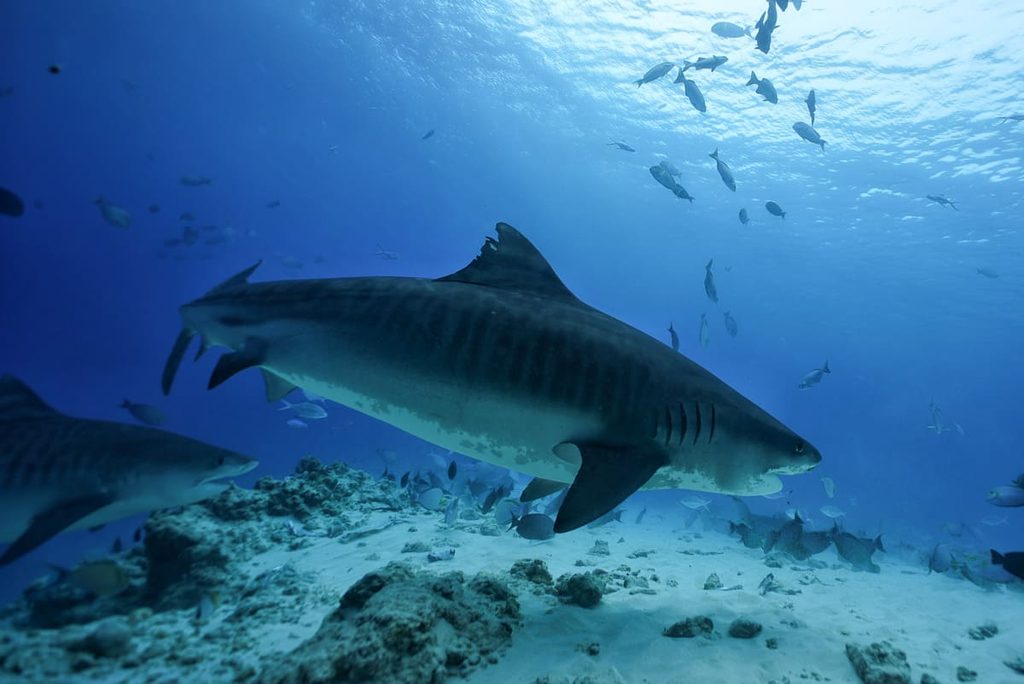
However, neither repeated sightings nor photo-identification at a single shallow site automatically establishes the total population around the island.
Any estimate suggesting more than 1,000 tiger sharks should therefore be distinguished from a verified, island-wide scientific census.
The Next Frontier: Exploring the Hidden Tiger-Shark Habitat
Future research could investigate deeper habitats using satellite-linked tags, acoustic telemetry, remote underwater cameras, environmental DNA and autonomous research platforms.
These methods could help answer several important questions:-
- How far offshore do tiger sharks associated with Fuvahmulah travel?
- What depths do they occupy when they are absent from Tiger Harbour?
- Do individual sharks regularly move between shallow reefs and deeper habitats?
- How do seasonal and environmental conditions influence their movements?
- How many tiger sharks use the wider area beyond the established observation sites?
The answers could improve our understanding of tiger-shark ecology and help guide evidence-based conservation and responsible marine tourism.
For divers, the appeal of Fuvahmulah is immediate: an extraordinary opportunity to observe one of the ocean’s most powerful predators. For scientists, the island offers a much bigger challenge—understanding the complete ecosystem behind those encounters.
A Diver’s Perspective: More Than a Shark Encounter
What makes Fuvahmulah memorable is not simply the presence of tiger sharks. It is the contrast between an intimate encounter in shallow water and the immense ocean surrounding the island.
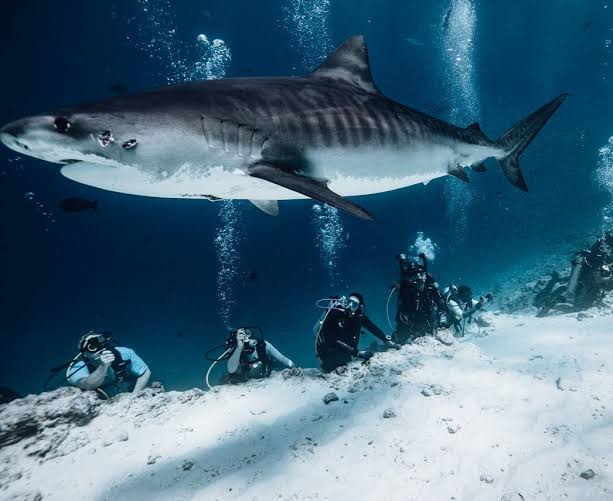
This editorial perspective captures the experience without presenting an invented quotation as a verified guest review. For publication, genuine reviews from identifiable guests can add useful first-hand evidence and travel context.
Frequently Asked Questions About Fuvahmulah’s Tiger Sharks
Where is Fuvahmulah’s famous tiger-shark dive site?
Tiger Harbour is located beside the harbour on Fuvahmulah, an isolated oceanic island in the Maldives, in the central Indian Ocean.
How deep is the Tiger Harbour dive?
Scientific research has documented the site at shallow depths, with recent standardized observations conducted below 11 metres.
How many tiger sharks have been identified in Fuvahmulah?
A landmark seven-year study identified 239 individual tiger sharks at the research site. This is a documented study count, not a complete census of the wider population.
Are there more than 1,000 tiger sharks around Fuvahmulah?
Estimates provided by local researchers, dive guides, conservationists, and experienced fishermen suggest that the marine environment of Fuvahmulah—including its deep ecosystems and southern submerged reef plateau—hosts an aggregation of over 1,000 resident and transient tiger sharks.
Caution is advised, however, as this figure requires validation through a systematic scientific population assessment.
What lies below the recreational diving limit?
Deeper reef slopes and open-ocean habitats extend beyond recreational diving depths. Their use by tiger sharks requires further investigation.
Why is Fuvahmulah important for tiger-shark research?
The island provides an unusually accessible location for repeated observations of tiger sharks, including individual identification, residency patterns and environmental influences on their presence.
The Hidden Depths of Fuvahmulah’s Tiger-Shark World
Tiger Harbour offers a remarkable window into tiger-shark behaviour. Tiger Wall reveals the dramatic underwater landscape beyond the encounter site.
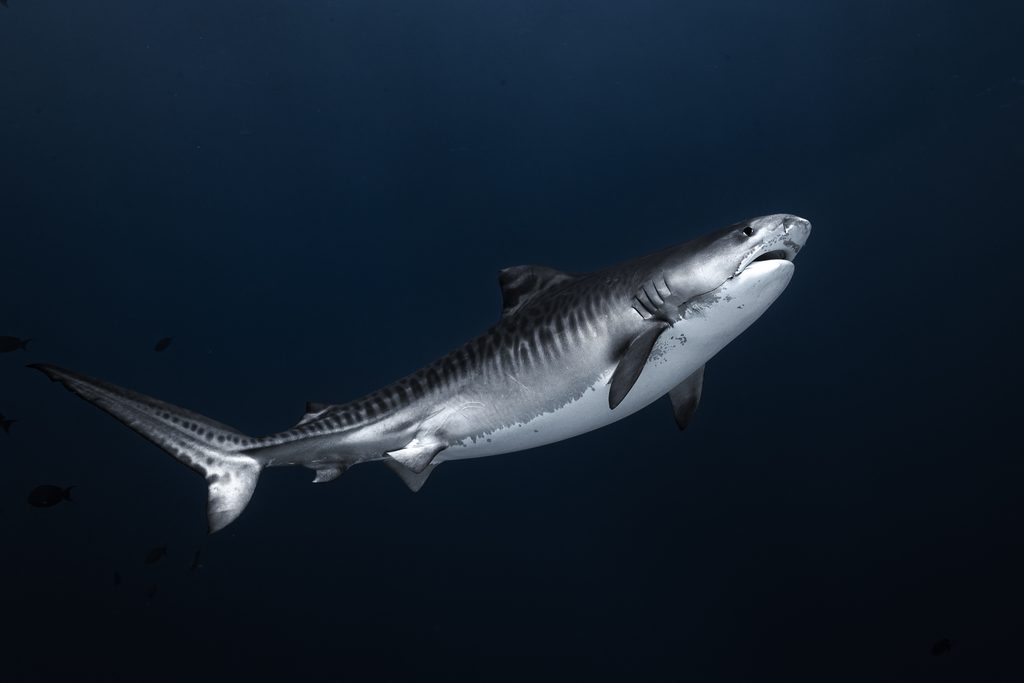
Fuvahmulah’s tiger-shark story is already extraordinary. Understanding what lies beyond the shallow dive sites could make it even more significant—for marine science, conservation and the future of responsible shark tourism in the Maldives.
🦈🪸 Exciting special offers for our readers are coming soon from our affiliated dive and accommodation partners in Fuvahmulah! Keep coming back, keep reading, and check in regularly at www.theislandinsights.com.
🌺🏝️ We are The Island Insights—bringing you the finest travel and lifestyle stories from the islands, from world-famous hot spots to hidden, off-the-beaten-path treasures you’ll fall in love with. ❤️🇲🇻🐠
🌊✨The Island Insights — Guiding your island journeys. From vibrant tropical lifestyles to rare, off-the-beaten-path discoveries, we bring you the ultimate island insights. 🐚🐬🌺
🏝️🐠🇲🇻❤️
www.theislandinsights.com
Photo courtesy of our affiliated partner dive centers of Fuvahmulah unless otherwise mentioned.
Leave a Reply